
About Paul Flood
Founder of The Optimistic Heart
Hi, I’m Paul.
Welcome to The Optimistic Heart, and to my story.
I’m grateful that you’re here because what you’ll find in these pages isn’t a motivational pitch. It’s a story about falling apart, waking up, and realizing that everything I’d been chasing was sitting quietly inside me all along.
Family, Love, and
What Really Matters
My wife, Brenda, and I have been married since 1980. We raised two amazing daughters, Kirsten and Shannon, who somehow grew up to be incredible humans despite my early years of “figuring things out.”
We have four grandkids who keep me laughing and remind me daily that joy doesn’t need a reason.
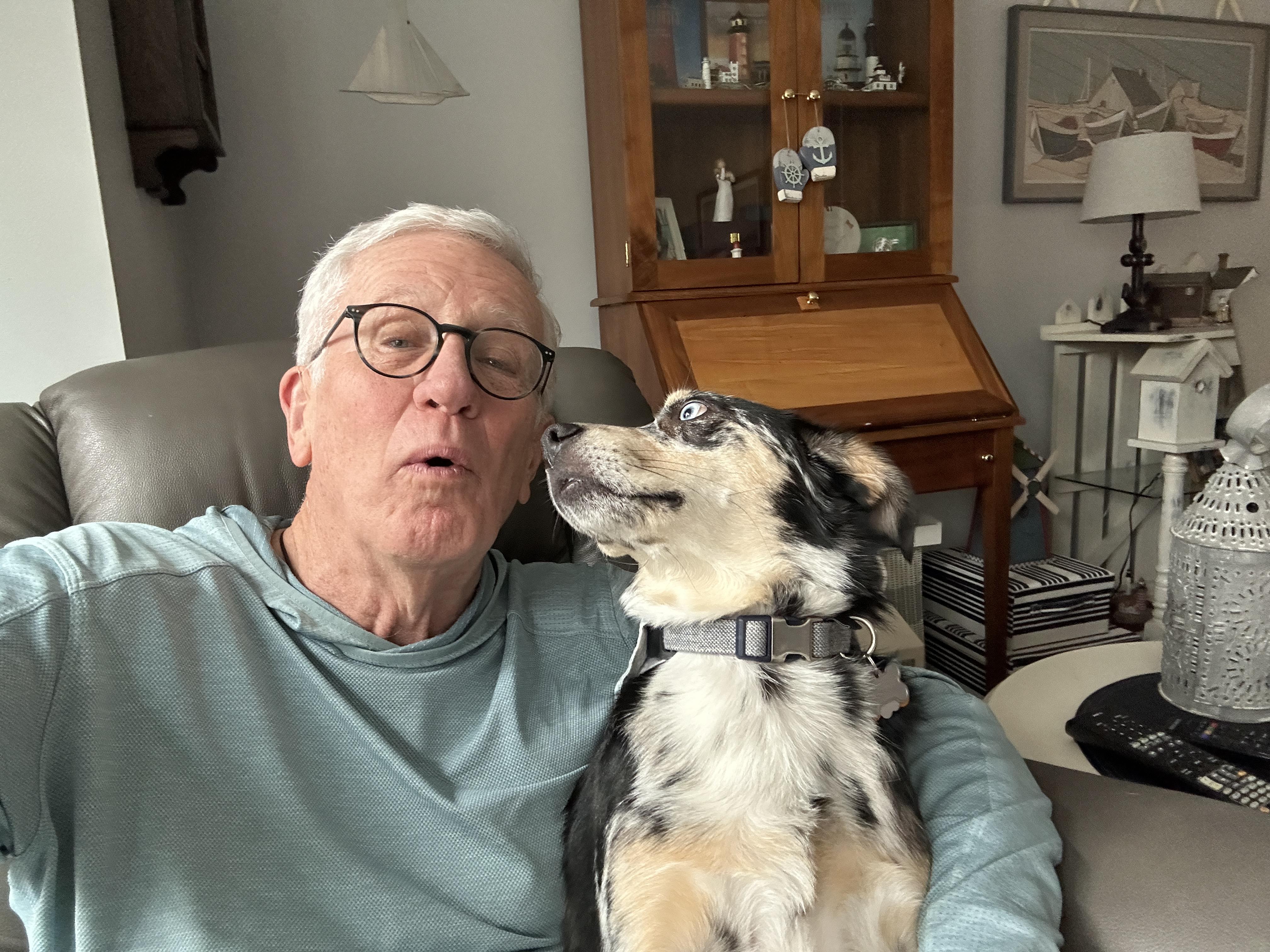
And then there’s Casey, my pup whose an Miniature Shepherd-Beagle-Boxer-Lab mix and my constant companion. An equal parts hiking partner, philosopher, and snoring sound machine. She’s been through many drafts of this story with me.
When I look at my family, I see the greatest proof of optimism there is, love that endures, expands, forgives, and always finds its way home.

The Fall
For a long time, I thought I was doing pretty well. Corporate career, six-figure income, good suits, decent hair. From the outside, it looked like success.
Inside, though, I was quietly drowning, in alcohol.
When the crash came, it wasn't graceful. I went from corporate comfort to counting change for groceries. I sold one of my cars just to get the lights turned back on. And still, I drank. Every day. A little more than the day before.
One morning, Brenda came into my office and said "please be here when I get home." She wasn't thinking I was going to leave her. It was her worry that I might do something drastic to escape my pain and myself.
Later that day, I found myself on the floor, shaking, crying, asking God to help me. I used to think scenes like that were for movies or bad novels.
When Brenda got home from work, we talked a bit and she said, "I'm calling your sisters for help," to which I replied, "Please do."
They came over. I lied about almost everything but I knew that something had to change and was ready to do something about it. My younger sister asked if I'd like to take a walk in a local park the next day and I said, "Yes."
While on our walk, she asked if I was still drinking and I said I was. She asked what ended up being a magic question: "Do you want to stop?"
I replied, "More than anything."
That was 2008. I haven't had a drop of alcohol since.
That night wasn't the end. It was the beginning. I chose a new life.
It wasn't a story or a movie. It was my life. And it became the moment my transformation began.
It's a bit ironic that I spent my adult life studying human behavior but generally ignored my own - and how my actions were quietly damaging me and everyone I cared about.


The Miracle
A Course in Miracles teaches that a miracle is a shift in perception from fear to love. And that’s exactly what happened.
Love showed up in many ways. In the form of Brenda’s patience, my sisters’ support, a few stubborn friends who wouldn’t let me disappear, and strangers in recovery meetings who somehow knew the exact words I needed.
I got sober.
I got humble.
And slowly, I got whole.
It wasn’t easy, but it was beautiful in ways I never expected. The teachings I’d studied since leaving college with a degree in Organizational Behavior included psychology, spirituality, peak performance, positive mental attitude, theosophy, NLP (Neuro Linguistic Programming), the Tao, Buddhism, the quantum realm, and many more, suddenly made sense.
They weren’t ideas anymore; they were living truths.
The Optimist in Me
I've always been an optimist - not because life has been kind, but because life has been honest.
An optimist doesn't deny pain. We just believe there's meaning in it. We trust that somewhere in the chaos, something better is trying to be born.
I can't control what happens around me, but I can always choose what happens in me. That choice - between fear and love - has become the foundation of everything I teach.
My Awakening
I woke up.
Not in some mystical flash of light, but in the quiet recognition that I was still here, and maybe, just maybe, I had something worth giving.
People started talking to me. Friends, coworkers, even strangers were sharing what was heavy in their hearts. I didn’t have answers, but I had ears. I listened, reflected, and offered what came through me.
They started saying things like: “Paul, you have to teach this.”
“Talking with you was like taking a brain shower.”
“You helped me see everything differently.”
It wasn’t planned. It just happened, like grace always does.
And that’s when The Optimistic Heart was born.
The Work I Do
Today, I help people who look “successful” on the outside but quietly feel empty on the inside.
People who’ve achieved the life they were told would make them happy, but can’t shake the feeling that something’s missing.
What I teach isn’t a secret formula. It’s a process of changing the conversation in your head... The one that says you’re not enough, that you have to earn love, that life happens to you instead of for you.
It’s about learning to see yourself through the eyes of love instead of fear. Because when you do, the world around you transforms.
You start noticing the small miracles — a quiet morning, a kind word, a breath that feels different.
The storms still come, but they don’t take you under anymore.
The Journey Ahead
Through The Optimistic Heart Transformation Quest and other programs, I share the tools and principles that helped me rebuild my life. These are courses that merge science, spirituality, and lived experience into something deeply practical and deeply human.
If you've read this far, you probably sense that there's more for you - more peace, more clarity, more connection.
You're right. Everything you've been searching for is already within you. You just have to learn how to listen again.
Ready to Begin?
If you're just starting to explore this work, The Optimistic Heart Daily Reconnect is the place to start.
A practical morning, afternoon, and evening practice for successful professionals who are ready to stop running on autopilot and start living from who they actually are and not the story success built around them.
When you're ready to go deeper, The Optimistic Heart Inner Critic Reset is where the real work begins.
A Closing Reflection:
I Am the Butterfly
Take a deep breath.
This isn’t just my story, it’s yours, too.
The moment you stop chasing and start listening, something within begins to stir, wings you’ve always had begin to move.
When you forget who you are, remember this…
