Stop Running on Autopilot
In Less Than 10 Minutes a Day
Use this free three-part daily practice to quiet the mental noise, interrupt the thoughts keeping you stuck, and reconnect with who you are beneath the roles, routines, and expectations of everyday life.
Your information is always kept private. No spam, ever.
The High-Achiever Paradox
“You Did Everything
You Were Told to Do.”
You kept going, handled your responsibilities, and became the person others could count on.
Yet somewhere along the way, you began feeling overwhelmed,
disconnected, or uncertain about the life you were living.
You learned how to handle whatever life asked of you. You worked, cared for others, solved problems, and kept moving forward, even when you were tired.
But lately, something feels different. You may feel overwhelmed by things you once handled easily, disconnected during moments that should matter, or unsure why the life that once fit no longer feels like your own.
“Autopilot isn’t a failure. It’s what happens when you spend so long responding to life that you lose touch with the person living it.”
Living on Autopilot
Waking up already thinking about everything you need to handle.
Moving from one responsibility to the next without feeling fully present.
Mistaking passing thoughts, fears, and self-criticism for the truth about who you are.
Feeling disconnected from yourself and the people or experiences that matter most.
Living Reconnected
Beginning your morning grounded in who you are before reacting to the world.
Noticing your thoughts without allowing them to define you or control your day.
Feeling more present and connected in your work, relationships, and everyday life.
Making choices from greater clarity instead of pressure, fear, or habit.
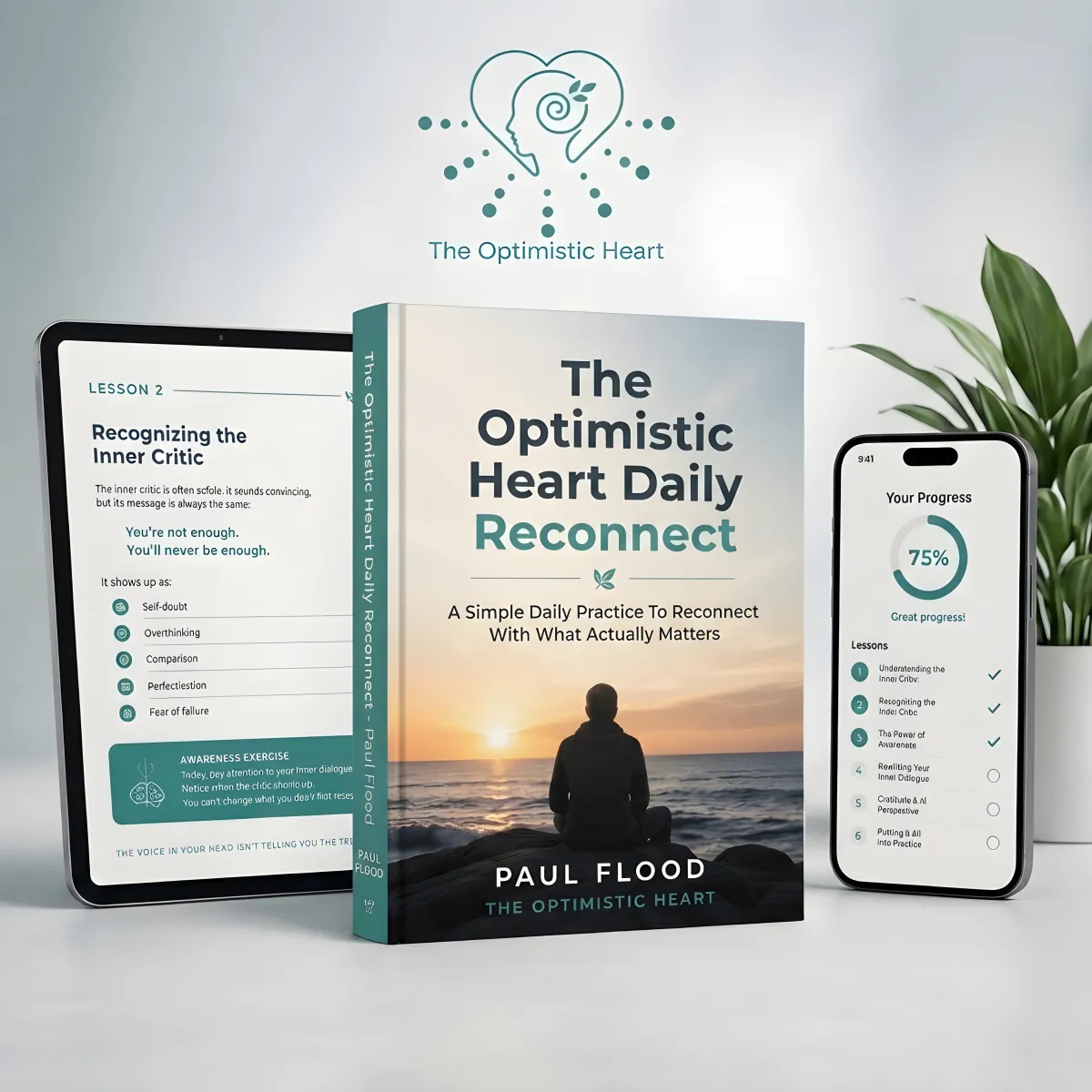
Free Download: The Optimistic Heart Daily Reconnect.
A simple morning, afternoon, and evening practice to help you step out of autopilot, quiet the mental noise, and reconnect with who you are beneath the roles, routines, and expectations of everyday life.
What You’ll Discover Inside This Free Guide:
How repetition trains your brain and why the thoughts you repeat begin to feel true.
The important difference between what you feel and who you are.
A simple three-stage daily practice you can complete in under ten minutes.
How the language you use shapes your identity and your experience of life.
How to create meaningful change through awareness instead of self-judgment or willpower.
Ready to start your 10-minute daily practice?
Take one small, intentional step out of autopilot and back toward clarity, presence, and what matters most.
Interactive Preview
Inside the 3-Stage Daily Reconnect Practice
A simple, science-backed framework designed to fit into under 10 minutes total per day.
Stage 1: Morning Anchor (3 Minutes)
Begin the day connected to yourself before reacting to everything waiting for you.
Key Steps in This Practice:
Separate Who You Are from What You Do: Remind yourself, “I am not my inbox, my calendar, or my to-do list.”
Take a 60-Second Stillness Break: Bring your attention to your breathing before checking your phone.
Choose Your Intention: Decide how you want to feel and how you want to meet the day, regardless of what happens around you.
“The way you enter your morning influences whether you meet the day from presence or pressure.”
Stage 2: Midday Check-In (2 Minutes)
Interrupt the momentum of the day before stress and mental noise take over.
Key Steps in This Practice:
Pause the Autopilot: Stop for two minutes between tasks, conversations, or responsibilities.
Notice the Inner Voice: Listen for thoughts driven by urgency, fear, or self-criticism.
Return to What Is Real: Ask, “Am I reacting to a thought, or responding to what is actually happening?”'
“A brief pause can help you move through the rest of your day with greater awareness and choice.”
Stage 3: Evening De-framing (4 Minutes)
Set down the mental weight of the day so you can rest and begin again tomorrow.
Key Steps in This Practice:
Close the Day: Give yourself permission to set aside unfinished tasks and responsibilities until tomorrow.
Separate Facts from Meaning: Write down three things that happened without turning them into judgments about yourself.Narrative
Reconnect with Yourself: Remember who you are beneath your roles, responsibilities, and titles.
“True rest begins when you stop carrying the story of the day into the night.”
"Paul helped me see my life and business in an entirely different light. He made a difference!"

"I now believe I can change my life. A lot of amazing things seem to be happening!"

"I’m grateful for Paul that you came in my life and helped me see this beautiful life and world with a different perspective."


Paul Flood
Transformational Guide | Founder of The Optimistic Heart
Meet Your Guide
Meet Paul Flood
Paul spent more than two decades in the business world, leading sales organizations, developing incentive programs for major corporations, and serving in senior volunteer leadership roles, including chairman of a 1,200-member chamber of commerce.
That experience taught him how to build things that worked on the outside. His deeper education came from discovering what happens when a life that appears to be working no longer feels right within.
In 2008, the life Paul had worked hard to build began to collapse. Rebuilding required more than a new plan or a quick reinvention. It meant confronting addiction, questioning long-held beliefs, and doing the quiet inner work that eventually led him back to sobriety, purpose, and himself.
That experience became the foundation of Paul’s work today. Along with his degree in Organizational Behavior, he brings decades of study and personal practice in spirituality, mindfulness, gratitude, forgiveness, personal development, and the ways our thoughts and language shape our lives.
Today, Paul guides people who have spent years doing what was expected of them but now feel overwhelmed, disconnected, or uncertain about what comes next. He helps them quiet the mental noise, recognize the patterns keeping them stuck, and reconnect with the wisdom already within them.
Paul doesn’t offer a formula for becoming someone new. He helps you recognize what has been buried beneath years of roles, expectations, and repeated stories.
The work is not about adding more to an already full life. It is about quieting the noise long enough to hear your own wisdom again.
The path back to yourself may be closer than it appears.
